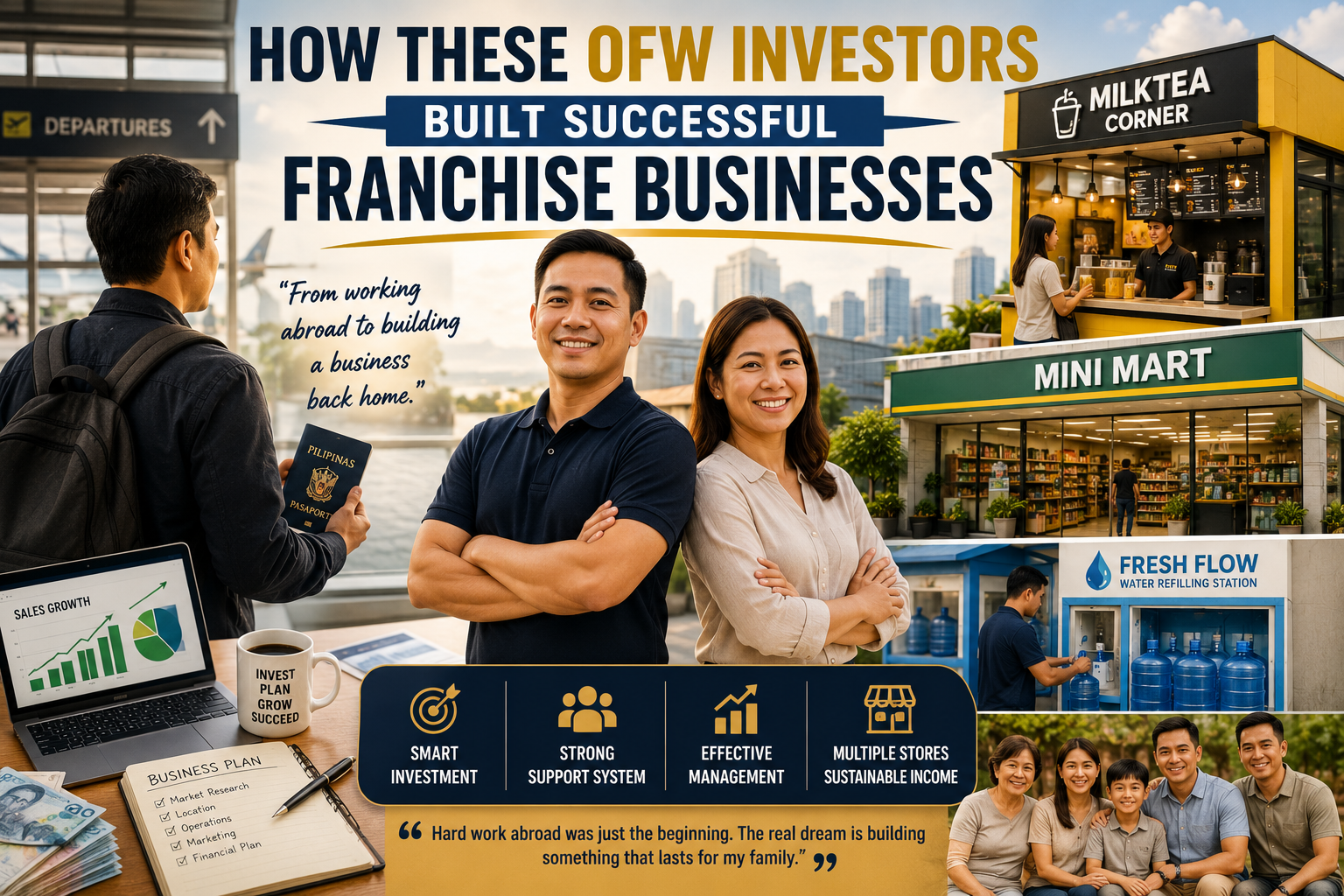
For millions of Overseas Filipino Workers (OFWs), working abroad is often motivated by a common goal: creating a better future for their families. While overseas employment can provide higher income opportunities, many OFWs eventually look for ways to generate sustainable earnings back home.
One of the most popular paths toward financial independence is franchising.
Unlike starting a business from scratch, franchising offers a proven business model, established brand recognition, and operational support. These advantages make franchising particularly attractive to OFWs who may not have extensive business experience but want to build long-term assets in the Philippines.
Over the years, many OFW investors have successfully transformed their overseas savings into profitable franchise businesses. Their stories offer valuable lessons for anyone considering a similar path.
Why Many OFWs Choose Franchising

After years of working abroad, many OFWs accumulate savings that they want to invest wisely.
While options such as real estate, stocks, and traditional businesses remain popular, franchising offers several advantages:
- Established business systems
- Brand recognition
- Training and operational support
- Faster startup process
- Lower learning curve
For many OFWs, franchising reduces some of the uncertainty associated with launching a completely new business.
Instead of developing products, branding, and operating procedures from the ground up, franchisees can focus on managing and growing the business.
Starting Small and Thinking Long-Term

One common characteristic among successful OFW franchise investors is that they often start with manageable investments.
Rather than investing millions immediately, many begin with:
- Food cart franchises
- Beverage kiosks
- Water refilling stations
- Convenience stores
- Small retail franchise outlets
These businesses allow investors to learn the fundamentals of entrepreneurship while limiting financial exposure.
Many successful franchise owners who now operate multiple branches started with a single location and gradually expanded over time.
Their strategy was simple: start small, learn the business, and grow when the numbers support expansion.
Turning Overseas Savings Into Income-Producing Assets

One challenge many OFWs face is ensuring that years of hard-earned savings continue to generate income after they return home.
Instead of spending savings on depreciating assets, successful OFW investors often focus on businesses that can produce recurring cash flow.
A franchise business can provide:
- Daily revenue opportunities
- Long-term asset growth
- Additional employment opportunities
- Financial security for family members
This shift from earning income through employment to generating income through business ownership is one of the key reasons many OFWs pursue franchising.
Involving Family Members in the Business

Many OFWs are unable to personally oversee operations during the early stages of the business.
As a result, family involvement often becomes a critical factor in success.
Spouses, siblings, parents, or adult children may help manage:
- Daily operations
- Staff supervision
- Inventory control
- Customer service
- Financial reporting
Businesses tend to perform better when family members are committed to maintaining the same standards and goals as the investor.
Strong communication between the OFW owner and local management team is often essential.
Choosing Essential-Service Franchises

Many successful OFW investors prefer franchise concepts that provide products or services people use regularly.
Popular choices often include:
- Convenience stores
- Water refilling stations
- Laundry businesses
- Quick-service food outlets
- Pharmacy and healthcare-related services
These businesses benefit from consistent demand regardless of economic conditions.
Rather than relying on trends, essential-service franchises often provide greater stability and predictable customer traffic.
Leveraging Franchise Support Systems

One major reason franchising appeals to OFWs is the support provided by franchisors.
Successful franchisees take advantage of:
- Initial training
- Operations manuals
- Marketing assistance
- Supply chain support
- Ongoing business guidance
These resources help reduce mistakes that first-time entrepreneurs commonly make.
Many OFW investors credit franchise support systems for helping them navigate unfamiliar aspects of business ownership.
Using Technology to Manage Businesses Remotely

Modern technology has made remote business ownership more practical than ever.
Today’s franchise owners can monitor:
- Sales reports
- Inventory levels
- Employee attendance
- Customer transactions
Using cloud-based systems and mobile applications.
For OFWs who remain abroad during the initial years of operation, access to real-time business data provides greater visibility and control.
Technology helps bridge the distance between investors and their businesses.
Reinvesting Profits for Expansion

Many successful OFW franchise owners follow a disciplined growth strategy.
Instead of withdrawing all profits, they reinvest earnings into:
- Additional branches
- Equipment upgrades
- Staff development
- Marketing efforts
This approach often accelerates business growth and increases long-term profitability.
Some entrepreneurs who started with a single kiosk or outlet eventually expanded into multiple locations through consistent reinvestment.
Learning From Challenges Along the Way

Not every franchise journey is smooth.
Successful OFW investors often encounter challenges such as:
- Staffing issues
- Location problems
- Market competition
- Operational inefficiencies
What separates successful entrepreneurs from unsuccessful ones is their willingness to adapt and solve problems.
Many experienced franchise owners view early setbacks as valuable learning experiences that ultimately strengthen their businesses.
Common Habits of Successful OFW Franchise Investors

While every story is different, many successful OFW franchisees share similar habits.
They Research Thoroughly
They evaluate franchise opportunities carefully before investing.
They Choose Businesses They Understand
Many focus on industries that match their interests or long-term goals.
They Build Reliable Teams
Strong local management helps maintain smooth operations.
They Reinvest for Growth
Profits become tools for expansion rather than immediate consumption.
They Remain Involved
Even from overseas, successful investors actively monitor business performance.
What Future OFW Investors Can Learn

The success stories of many OFW franchise owners highlight several important lessons:
- Start with a realistic budget.
- Focus on businesses with sustainable demand.
- Build trustworthy local management.
- Take advantage of franchise training and support.
- Reinvest profits whenever possible.
- Be patient and think long-term.
Franchising is not a guaranteed path to success, but it can provide a structured route toward business ownership and financial independence.
Final Thoughts
For many OFWs, franchising has become more than just an investment—it has become a pathway toward returning home with a sustainable source of income.
By combining hard-earned savings with proven business models, numerous overseas workers have successfully transitioned from employees abroad to business owners in the Philippines.
Their journeys demonstrate that successful entrepreneurship is not always about making huge investments. It is often about making smart decisions, managing risks carefully, and consistently building on small successes.
Whether you’re currently working overseas or planning your future return, franchising may offer an opportunity to transform years of hard work into a lasting business legacy for you and your family.