Starting a franchise business is one of the smartest ways to enter entrepreneurship in the Philippines. You get a proven system, a recognizable brand, and ongoing support—without starting from scratch.
But here’s the reality: not all franchises fit your budget.
Many first-time investors get excited about popular brands, only to realize later that they underestimated the total cost. That’s why choosing the right franchise isn’t just about the brand—it’s about finding one that aligns with your financial capacity.
This guide will walk you through how to choose the best franchise for your budget, step by step, in a practical and realistic way.
1. Start With Your Real Budget (Not Just Your Savings)
Before looking at franchise options, take a step back and define your real budget.
Many people make the mistake of thinking:
“I have ₱500,000, so I can invest ₱500,000.”
That’s risky.
Instead, you should only invest a portion of your capital and keep a buffer for emergencies and operations.
What to Consider:
- Your total available capital
- Emergency savings (at least 3–6 months)
- Monthly personal expenses
- Other financial obligations
A safer approach is to allocate 70–80% of your funds to the business and keep the rest as a safety net.
2. Understand the Full Cost of a Franchise
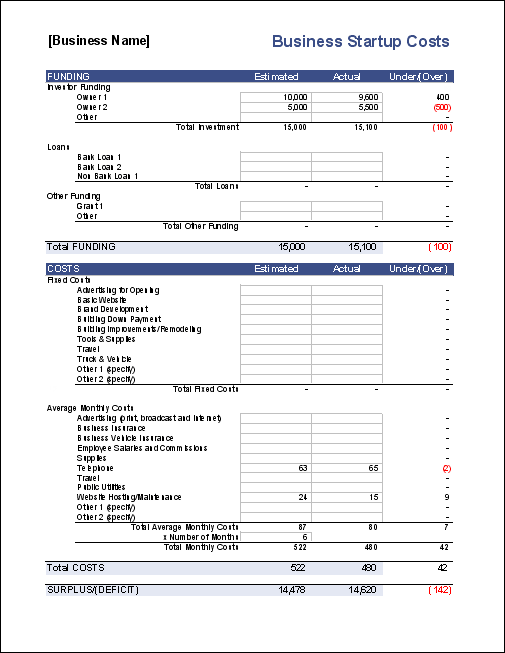
The franchise fee is just one part of the equation. Many beginners underestimate the total investment required.
Common Costs Include:
- Franchise fee
- Equipment and supplies
- Store construction or renovation
- Rental deposit and advance
- Business permits and licenses
- Initial inventory
- Staff salaries
- Marketing expenses
- Working capital (for at least 3 months)
For example, a “₱300,000 franchise” may actually require ₱500,000–₱700,000 total when everything is included.
Always ask the franchisor for a complete cost breakdown.
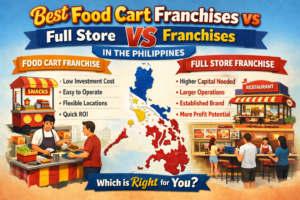
3. Match the Franchise Type to Your Budget

Different franchise types require different levels of investment. Choosing the right category helps narrow your options quickly.
Budget-Based Franchise Options:
₱50,000 – ₱300,000
- Food carts (siomai, fries, milk tea)
- Small kiosks
- Home-based services
₱300,000 – ₱1,000,000
- Coffee kiosks
- Small retail stores
- Water refilling stations
- Laundry services
₱1M – ₱5M
- Full café setups
- Mid-sized restaurants
- Convenience stores
₱5M+
- Large fast-food chains
- Full-service restaurants
- Premium franchise brands
Choosing within your range helps avoid financial strain later on.
4. Consider Profitability vs Affordability
Just because a franchise is affordable doesn’t mean it’s profitable—and vice versa.
Some low-cost franchises:
- Have lower daily sales
- Depend heavily on location
- Take longer to scale
Meanwhile, higher-cost franchises:
- May generate higher daily revenue
- Benefit from strong brand recognition
- Have better systems and support
Key Question:
“Can this business generate enough income to cover my costs and still make a profit?”
Look at:
- Average daily sales
- Profit margins
- Break-even timeline
A slightly more expensive franchise with better returns may be a smarter investment.
5. Evaluate the Support System

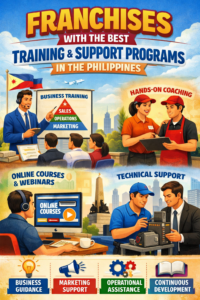
One of the biggest advantages of franchising is support—but not all brands provide the same level.
A strong franchisor should offer:
- Pre-opening training
- Operations manual
- Marketing assistance
- Ongoing support and supervision
If you’re a first-time entrepreneur, this support is extremely valuable. It can help you avoid costly mistakes and run your business more efficiently.
6. Study the Location and Market Demand

Even the best franchise can fail in the wrong location.
Before choosing a franchise, study:
- Foot traffic
- Nearby competitors
- Target customers
- Spending habits in the area
For example:
- Food carts do well near schools and terminals
- Coffee shops thrive in business districts
- Laundry services work best in residential areas
Your location should match your business concept.
7. Be Honest About Your Lifestyle and Involvement

Some franchises require hands-on management, while others can run with minimal supervision.
Ask yourself:
- Do I have time to manage daily operations?
- Do I prefer a passive or active business?
- Can I handle staff and customer service?
For example:
- Food businesses require daily supervision
- Laundry and water stations can be semi-passive
- Retail stores require inventory management
Choosing a business that fits your lifestyle increases your chances of long-term success.
8. Talk to Existing Franchisees

One of the best ways to evaluate a franchise is to talk to people who are already running it.
Ask them:
- Is the business profitable?
- How long did it take to break even?
- What challenges do they face?
- Is the franchisor supportive?
Real-world insights are often more valuable than marketing brochures.
Final Thoughts
Choosing the best franchise for your budget isn’t about finding the cheapest option—it’s about finding the right balance between cost, profitability, and sustainability.
Take your time to:
- Understand the full investment
- Match the franchise to your budget
- Evaluate support and profitability
- Study your target location
A well-chosen franchise can become a stable and rewarding business. But rushing into the wrong one can lead to unnecessary financial stress.
At the end of the day, the goal is simple:
Start a business you can afford—and grow one you can sustain.