Before investing in a franchise, one of the most important questions you should ask is:
“How long will it take to recover my investment?”
The answer lies in calculating your Return on Investment (ROI) and estimating your break-even point. While no business can guarantee profits, understanding these financial metrics helps you make smarter investment decisions and compare different franchise opportunities.
This guide explains how ROI and break-even analysis work, provides simple formulas, and walks you through real-world examples tailored to aspiring franchise owners in the Philippines.
What Is Franchise ROI?

Return on Investment (ROI) measures how much profit you earn relative to the amount you invested.
A higher ROI generally means your investment is generating better returns.
The basic ROI formula is:
ROI (%) = (Net Profit ÷ Total Investment) × 100
For example:
- Total Investment: ₱800,000
- Annual Net Profit: ₱320,000
ROI = (₱320,000 ÷ ₱800,000) × 100 = 40%
This means your franchise generates an annual return equivalent to 40% of your initial investment.
What Is the Break-Even Point?
The break-even point is the moment when your total earnings equal your total investment.
At this point, you’ve recovered every peso you’ve invested. Any profit earned after that represents your actual return.
For example:
- Initial Investment: ₱1,000,000
- Monthly Net Profit: ₱50,000
Break-even period:
₱1,000,000 ÷ ₱50,000 = 20 months
If your profits remain consistent, you’ll recover your investment in approximately 1 year and 8 months.
To better understand how fixed costs, selling price, and variable costs affect your break-even point, explore the interactive visualization below.10203040506050010001500RevenueTotal costQuantity$Q*
Q∗=p−vF=32−12400=20
Why Every Franchise Investor Should Calculate ROI

Calculating ROI before buying a franchise helps you:
- Compare multiple franchise brands objectively
- Estimate how long it will take to recover your investment
- Determine whether projected profits justify the investment
- Assess financial risks
- Prepare realistic cash flow expectations
- Improve your chances of securing financing from banks or investors
Never invest based solely on the popularity of a franchise. Always evaluate its financial potential.
Franchise ROI Calculator: Step-by-Step Example
Let’s examine a practical example.
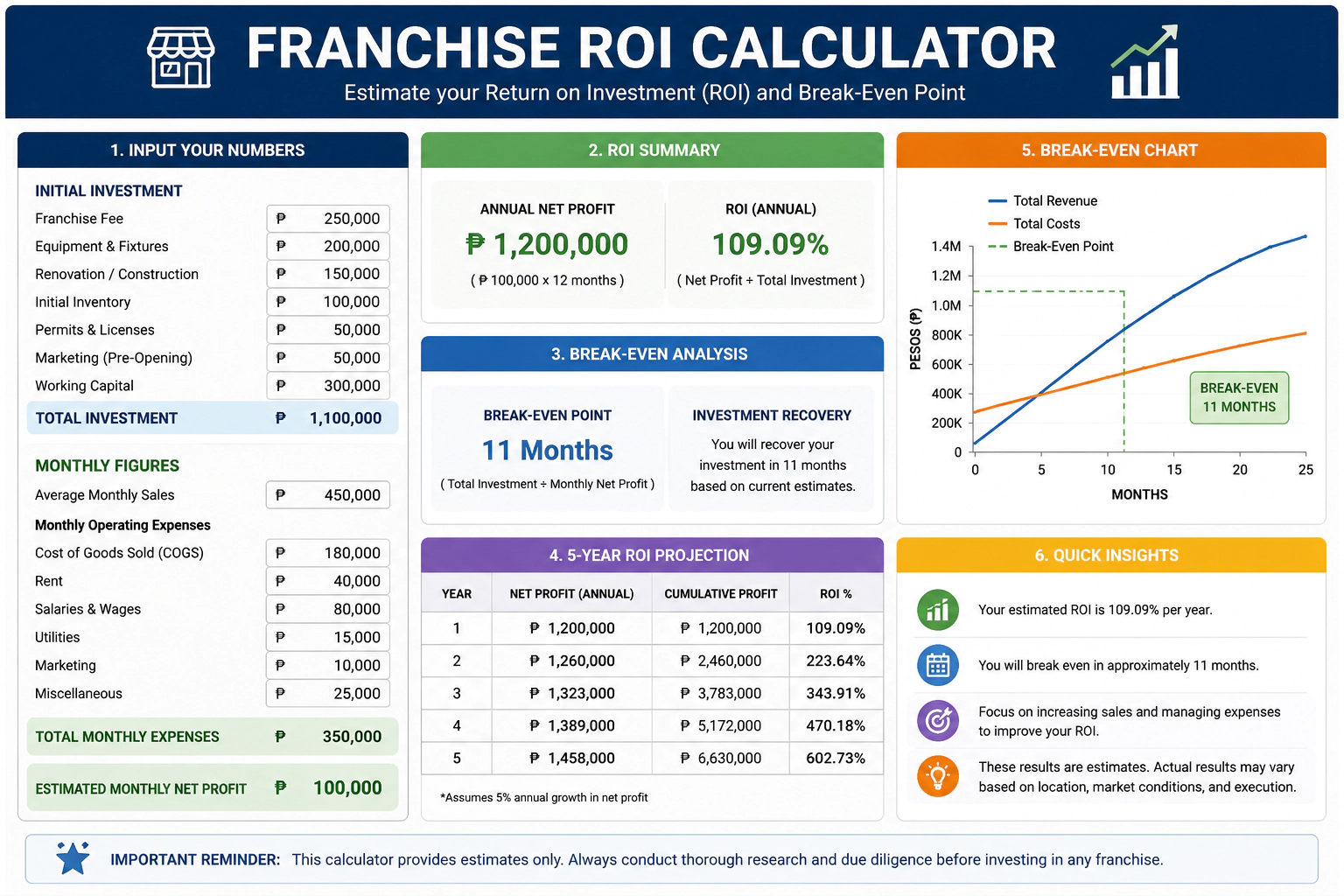
Initial Investment
| Expense | Amount |
|---|---|
| Franchise Fee | ₱250,000 |
| Equipment | ₱200,000 |
| Renovation | ₱150,000 |
| Initial Inventory | ₱100,000 |
| Working Capital | ₱300,000 |
| Total Investment | ₱1,000,000 |
Monthly Sales
- Gross Sales: ₱450,000
Monthly operating expenses:
- Cost of Goods Sold: ₱180,000
- Rent: ₱40,000
- Salaries: ₱80,000
- Utilities: ₱15,000
- Marketing: ₱10,000
- Miscellaneous: ₱25,000
Monthly Net Profit: ₱100,000
ROI Calculation
Annual Net Profit:
₱100,000 × 12 = ₱1,200,000
ROI:
(₱1,200,000 ÷ ₱1,000,000) × 100
= 120% Annual ROI
Break-Even Estimate
₱1,000,000 ÷ ₱100,000
= 10 Months
Under these assumptions, you’d recover your investment in less than one year.
Factors That Affect Your ROI

Every franchise performs differently depending on several factors.
Location
High-foot-traffic areas often generate more sales but usually come with higher rental costs.
Brand Recognition
Well-known franchise brands generally attract customers faster than newer businesses.
Operating Costs
Controlling labor, utilities, inventory waste, and rent improves profitability.
Management Skills
Efficient inventory management and excellent customer service can significantly improve profit margins.
Competition
Nearby competitors may reduce sales if your location isn’t carefully selected.
Economic Conditions
Inflation, consumer spending, and seasonal demand all influence business performance.
Common ROI Mistakes
Avoid these common errors:
Overestimating Sales
Use conservative revenue projections instead of best-case scenarios.
Ignoring Hidden Costs
Include permits, insurance, taxes, maintenance, equipment replacement, and marketing.
Forgetting Working Capital
A business may be profitable but still fail if it runs out of cash.
Assuming Immediate Success
Many franchises take several months to build a loyal customer base.
Ignoring Taxes
Always calculate profit after taxes whenever possible.
Questions to Ask the Franchisor
Before investing, ask:
- What are the average monthly sales of existing franchisees?
- What are the average operating expenses?
- How long do most franchisees take to break even?
- What is the average ROI after one year?
- What financial assumptions were used in the projections?
- Are there additional recurring fees beyond royalties?
- Can I speak with existing franchise owners?
The more information you gather, the more accurate your ROI estimates will be.
Ways to Improve Your Franchise ROI
You can improve profitability by:
- Choosing a strategic location
- Keeping operating costs under control
- Training employees effectively
- Reducing inventory waste
- Upselling complementary products
- Running local marketing campaigns
- Leveraging social media advertising
- Monitoring financial reports monthly
Small operational improvements can significantly increase long-term returns.
Is a High ROI Always Better?
Not necessarily.
Some franchises advertise extremely high projected returns, but those estimates may rely on overly optimistic assumptions.
When evaluating ROI, also consider:
- Investment risk
- Brand reputation
- Franchise support
- Market demand
- Industry stability
- Competition
- Scalability
A franchise with a slightly lower ROI but a stronger brand and better support system may offer a more reliable long-term investment.
Final Thoughts
Calculating your franchise ROI and estimating your break-even point are essential steps before making any investment. They help you understand how quickly you may recover your capital, compare different franchise opportunities, and set realistic expectations for profitability.
While formulas provide useful estimates, remember that actual performance depends on location, management, operating costs, customer demand, and market conditions. Use ROI as one of several tools when evaluating a franchise—not the only one.
By combining careful financial planning with thorough research, you’ll be in a stronger position to choose a franchise that aligns with both your budget and your long-term business goals.
Frequently Asked Questions
What is a good ROI for a franchise?
Many investors consider an annual ROI of 20% to 40% attractive, although it varies widely depending on the industry, investment size, and business risk.
How long does it usually take to break even?
Many franchises recover their investment within 12 to 36 months, though some businesses may break even sooner or take longer depending on sales performance and operating expenses.
Can ROI guarantee franchise success?
No. ROI is based on projections and assumptions. Actual profitability depends on effective management, location, competition, customer demand, and economic conditions.
Should I compare multiple franchises?
Absolutely. Comparing investment costs, expected ROI, break-even timelines, franchise support, and brand reputation can help you make a more informed decision.