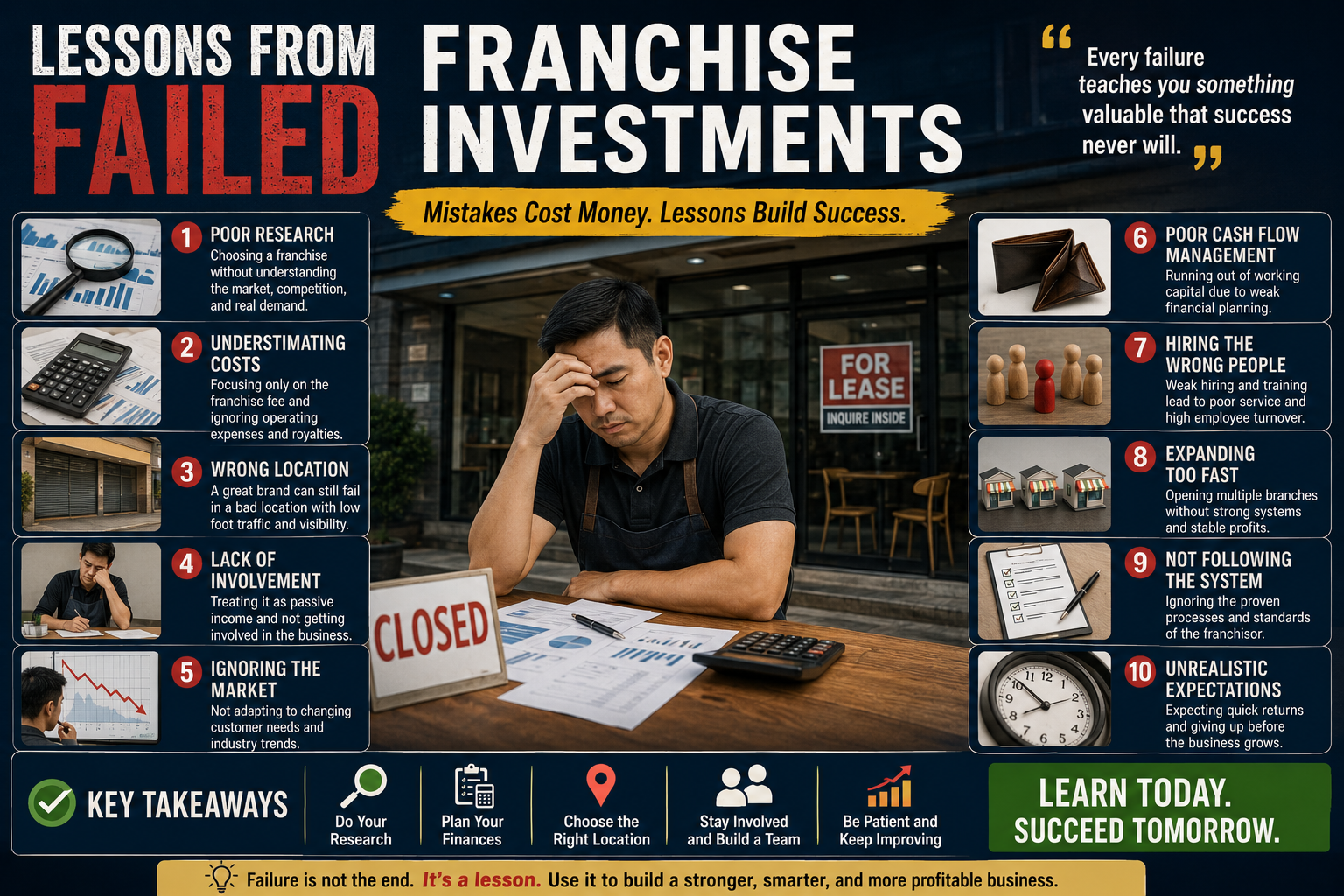
Franchising is often promoted as a safer path to business ownership because it provides an established brand, proven systems, and operational support. While these advantages can improve the chances of success, they do not eliminate risk.
Every year, some franchise investments fail—not because franchising itself is flawed, but because investors make avoidable mistakes before or after opening their businesses.
The good news is that failed franchise investments offer valuable lessons. By understanding what went wrong for others, aspiring franchisees can make smarter decisions and avoid costly errors.
Here are some of the most common reasons franchise investments fail and the lessons every entrepreneur can learn from them.
1. Choosing a Franchise Based Solely on Popularity

One of the biggest mistakes investors make is choosing a franchise simply because it is trendy or popular.
Many entrepreneurs assume that a well-known brand automatically guarantees success. However, popularity alone does not determine profitability.
A franchise may have:
- High franchise fees
- Intense competition
- Expensive operating franchise costs
- Limited market demand in certain locations
Some investors become excited about a trending concept without fully analyzing whether it fits their local market.
Lesson:
Don’t invest based on hype. Study the business model, financial requirements, and local demand before making a decision.
2. Underestimating Operating Expenses

Many first-time franchisees focus heavily on the initial investment cost but overlook ongoing expenses.
Common operating costs include:
- Rent
- Utilities
- Employee salaries
- Inventory
- Marketing expenses
- Equipment maintenance
Some businesses generate healthy sales but still struggle because expenses are higher than expected.
When cash reserves run out, operations become difficult to sustain.
Lesson:
Always prepare a detailed financial projection and maintain sufficient working capital beyond the initial franchise investment.
3. Choosing the Wrong Location

Location remains one of the most important factors in franchise success.
Many failed franchises suffer from:
- Low foot traffic
- Poor visibility
- Limited accessibility
- Inadequate parking
- Weak surrounding demographics
Even strong brands can struggle if customers rarely pass by the location.
Some investors become attracted to lower rental rates without considering customer traffic.
Lesson:
A cheaper location is not always a better location. Analyze customer behavior, accessibility, and foot traffic before signing a lease.
4. Treating the Franchise as Passive Income

Many investors enter franchising expecting passive income.
They assume the brand will operate successfully with little involvement from the owner.
In reality, most successful franchisees remain actively engaged, especially during the early years.
Businesses often struggle when owners:
- Rarely visit operations
- Fail to monitor finances
- Ignore customer feedback
- Depend entirely on employees
Lesson:
Even with a proven system, franchising still requires active management and leadership.
5. Ignoring Market Research

Some franchise failures occur because investors assume demand exists without verifying it.
A business that performs well in one city may not succeed in another.
Factors that affect demand include:
- Income levels
- Consumer preferences
- Competition
- Population density
Without proper research, entrepreneurs may invest in concepts that do not align with local customer needs.
Lesson:
Study your target market carefully before investing. Demand matters more than personal preference.
6. Expanding Too Quickly

Growth is exciting, but expansion can become dangerous when it happens too fast.
Some franchisees open additional branches before:
- Stabilizing existing operations
- Building sufficient cash reserves
- Developing management systems
Rapid expansion can create:
- Cash flow problems
- Staffing challenges
- Operational inconsistencies
Lesson:
Master one location before expanding to the next. Sustainable growth is often more profitable than rapid growth.
7. Hiring the Wrong People

Employees directly influence customer satisfaction and business performance.
Poor hiring decisions often result in:
- High turnover
- Inconsistent service
- Inventory losses
- Low productivity
Some franchise owners rush the hiring process or fail to provide proper training.
Lesson:
Invest time in recruitment, training, and employee development. Strong teams are critical to franchise success.
8. Failing to Adapt to Changing Consumer Behavior

Consumer preferences constantly evolve.
Businesses that ignore changing trends often struggle to remain competitive.
Examples include:
- Refusing digital payments
- Ignoring food delivery services
- Neglecting social media marketing
- Failing to improve customer experience
Successful franchisees adapt to market changes rather than resisting them.
Lesson:
Stay informed about industry trends and be willing to evolve with customer expectations.
9. Not Understanding the Franchise Agreement

Some investors sign franchise agreements without fully understanding the terms.
Important areas often include:
- Royalty fees
- Territory restrictions
- Renewal conditions
- Supplier requirements
- Exit clauses
Misunderstandings can lead to unexpected costs and operational limitations.
Lesson:
Review all franchise documents carefully and seek professional advice if necessary.
10. Expecting Immediate Results

Many new franchisees become discouraged when profits do not appear immediately.
Building a successful business takes time.
Factors such as:
- Brand awareness
- Customer acquisition
- Staff development
- Operational improvements
often require months—or even years—to fully develop.
Some investors abandon promising businesses simply because they expected faster returns.
Lesson:
Approach franchising with realistic expectations and a long-term perspective.
Common Traits of Successful Franchise Investors
Interestingly, many successful franchise owners avoid failure by consistently practicing a few key habits:
They Research Thoroughly
They understand the business before investing.
They Monitor Financial Performance
They regularly review revenue, expenses, and profitability.
They Stay Involved
They actively participate in operations.
They Build Strong Teams
They prioritize employee development and accountability.
They Think Long-Term
They focus on sustainable growth instead of quick profits.
Final Thoughts
Failed franchise investments can be disappointing, but they also provide some of the most valuable lessons in business.
Most failures are not caused by bad luck alone. They often result from avoidable mistakes such as poor planning, inadequate research, weak management, or unrealistic expectations.
The encouraging news is that these mistakes can be learned from.
If you’re considering a franchise investment, take the time to:
- Conduct thorough research
- Understand the financials
- Evaluate the market
- Stay actively involved
- Plan for long-term growth
Success in franchising is rarely about finding a perfect opportunity. More often, it’s about making informed decisions and managing the business effectively after the investment is made.
By learning from the mistakes of others, you can significantly improve your chances of building a profitable and sustainable franchise business.