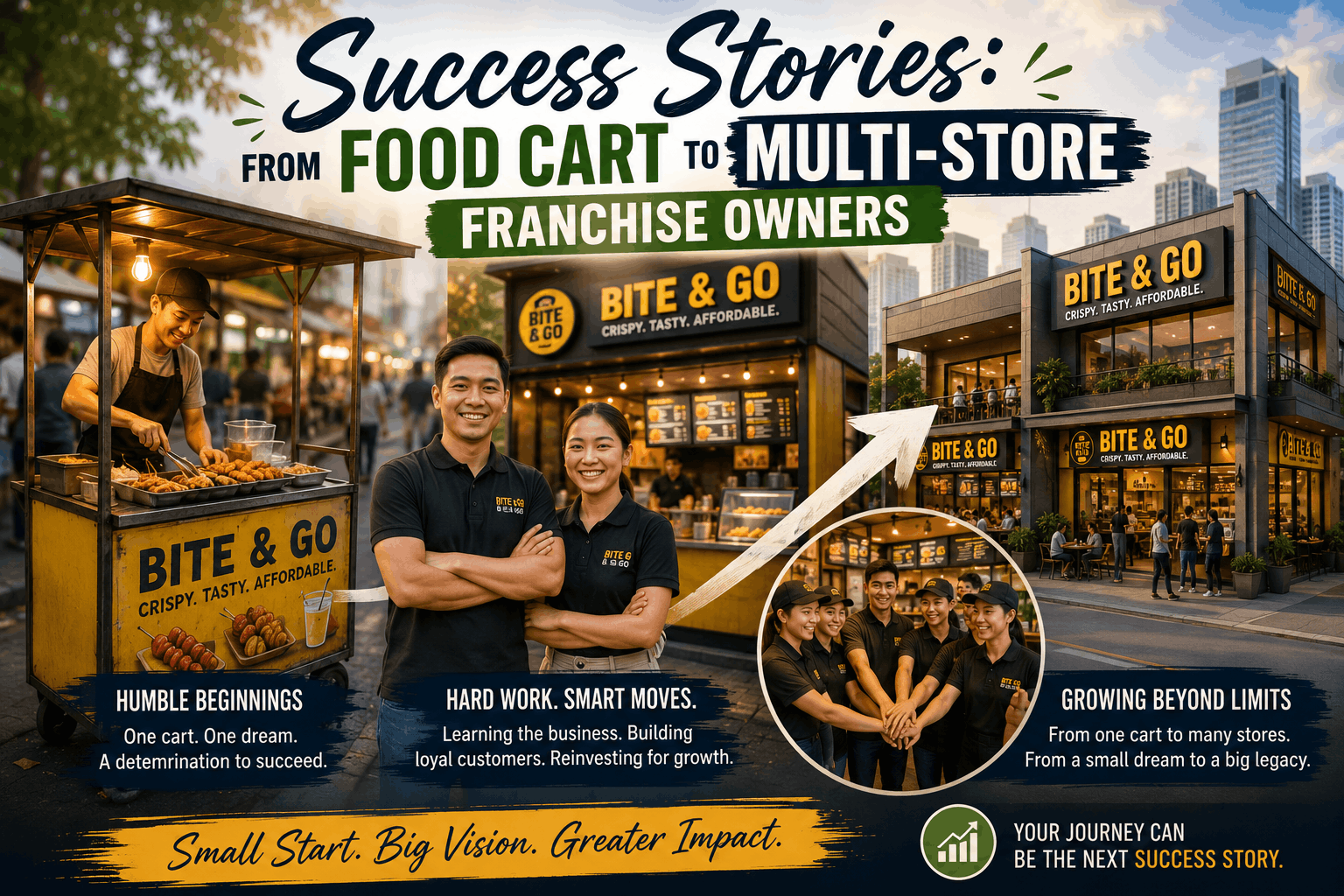
One of the most inspiring aspects of franchising in the Philippines is the number of entrepreneurs who started with humble beginnings and gradually built thriving businesses. While many people assume that successful franchise owners begin with large amounts of capital, countless real-world examples prove otherwise.
Across the country, food carts have served as stepping stones for aspiring business owners. What often begins as a single kiosk in a mall, school, or transport terminal can eventually grow into multiple branches, providing financial stability and long-term wealth.
These success stories demonstrate that franchising is not just about buying a business—it’s about dedication, smart decision-making, and a willingness to grow.
Here’s a closer look at how many Filipino entrepreneurs have transformed a simple food cart investment into a multi-store business success.
Why Food Cart Franchises Are Popular Starting Points

Food cart franchises have long been considered one of the most accessible ways to enter the world of business ownership.
Compared to larger restaurant franchises, food carts typically offer:
- Lower startup costs
- Simpler operations
- Smaller staffing requirements
- Faster setup times
- Easier management
Many food cart franchises can be launched with investments ranging from ₱100,000 to ₱500,000, making them attractive to first-time entrepreneurs, employees, OFWs, and young professionals.
The lower barrier to entry allows investors to gain valuable business experience while minimizing financial risk.
The First Cart: Learning the Fundamentals

For many successful franchisees, the first food cart serves as a learning experience.
During this stage, owners learn critical business skills such as:
- Inventory management
- Customer service
- Staff supervision
- Cash flow monitoring
- Marketing and promotions
The first few months are often the most challenging.
Many entrepreneurs discover that success requires more than simply purchasing a franchise package. Daily involvement, operational discipline, and customer engagement play major roles in building a profitable business.
Those who embrace these lessons are often better prepared for future expansion.
Building a Loyal Customer Base

One factor that separates successful food cart owners from struggling ones is their ability to build customer loyalty.
Profitable operators focus on:
- Consistent product quality
- Friendly customer service
- Clean presentation
- Fast transactions
- Strategic promotions
Over time, regular customers become an important source of steady revenue.
Many successful franchisees understand that a loyal customer base provides the foundation needed to support future growth.
Rather than chasing quick profits, they focus on delivering a consistently positive customer experience.
Reinvesting Profits Instead of Spending Them

One common theme among multi-store franchise owners is their commitment to reinvestment.
Instead of immediately spending profits on personal purchases, successful entrepreneurs often use earnings to:
- Upgrade equipment
- Improve operations
- Increase inventory
- Fund additional locations
This disciplined approach allows small businesses to grow steadily over time.
Many owners who now operate multiple branches started by reinvesting nearly every peso of profit during their early years.
Their focus was not on short-term rewards but on building long-term business value.
Expanding to a Second Location

Opening a second branch is often the most important milestone in a franchise owner’s journey.
A second location proves that success is not dependent on a single site.
Before expanding, experienced franchisees typically evaluate:
- Sales performance
- Market demand
- Staffing requirements
- Location opportunities
- Cash reserves
Successful expansion requires careful planning.
Entrepreneurs who rush into growth without strong systems often encounter operational difficulties.
Those who expand strategically are better positioned for sustainable success.
Developing Systems for Growth

As businesses grow, owners can no longer personally oversee every transaction.
This is where systems become essential.
Successful multi-store franchisees often implement:
- Standard operating procedures
- Staff training programs
- Inventory controls
- Sales reporting systems
- Performance tracking tools
Strong systems ensure consistency across locations.
Without them, expansion can create more problems than opportunities.
Many experienced entrepreneurs believe that systems—not luck—are what allow businesses to scale effectively.
Building and Managing Teams

Another major challenge during expansion is staffing.
The owner who once managed everything alone must learn to lead a growing team.
Successful franchise operators invest heavily in:
- Employee training
- Leadership development
- Performance monitoring
- Positive workplace culture
Reliable employees help ensure that customers receive the same quality experience at every location.
Many franchise owners credit their teams as one of the biggest factors behind their growth.
From Food Cart to Full-Scale Store

Some entrepreneurs eventually outgrow the food cart model altogether.
After building multiple kiosk locations, they may expand into:
- Standalone stores
- Cafés
- Quick-service restaurants
- Larger retail concepts
Their experience operating food carts provides valuable insights that reduce the risks associated with larger investments.
What began as a small franchise often becomes the foundation for a much larger business portfolio.
Lessons From Successful Franchise Owners

While every journey is unique, many successful franchisees share similar habits.
They Start Small but Think Long-Term
They focus on sustainable growth rather than immediate expansion.
They Learn Continuously
Successful owners constantly improve their understanding of business operations.
They Reinvest Their Earnings
Profits become fuel for future growth.
They Build Strong Teams
Reliable employees support expansion and consistency.
They Focus on Customer Satisfaction
Happy customers create repeat business and long-term success.
Can You Follow the Same Path?
While every business carries risk, the path from food cart owner to multi-store operator remains achievable for many aspiring entrepreneurs.
Success rarely happens overnight.
Most thriving franchise owners spend years:
- Learning the business
- Building customer relationships
- Improving operations
- Expanding strategically
The journey requires patience, discipline, and commitment.
However, for those willing to put in the effort, a small food cart can become much more than a side business—it can become the foundation of a thriving entrepreneurial future.
Final Thoughts
Some of the most successful franchise stories in the Philippines began with a single food cart and a determined entrepreneur.
These business owners did not necessarily have large amounts of capital or extensive business experience. What they had was a willingness to learn, work hard, and reinvest in growth.
Their journeys offer an important lesson for aspiring investors:
Big business success often starts with a small opportunity.
Whether you’re considering your first franchise or planning your next investment, remember that many multi-store franchise owners started exactly where you are today—with one location, one goal, and the determination to make it succeed.